
Remembering a Forgotten Fibre.
Long before “innovation” became a buzzword, people were already spinning remarkable fibres from unexpected sources.
Using dog undercoat as a textile fibre isn’t new. Indigenous communities in North America and Scandinavia lived alongside and intentionally bred dogs prized for their soft, insulating undercoats. The Salish Wool Dog, now extinct, was shorn and spun much like sheep, its fibre woven into blankets that were both functional and culturally significant. These were not curiosities; they were everyday materials, deeply integrated into life, care and craft.
Even in Britain, dog wool briefly re-entered industrial consciousness under wartime pressure. As documented in Sandra Miller’s archival research for ChowTales, severe shortages of sheep’s wool during the First World War prompted the creation of the British Dog Wool Association. Dog owners in Kensington were encouraged to save brushed-out fur, which was spun into yarn and knitted into garments for soldiers. At Burlington House — home of the Royal Academy — the British Red Cross and the Order of St John converted galleries into temporary workrooms where more than 1,200 volunteers produced upwards of 73,000 garments and over 700,000 bandages. As wool supplies dwindled, spinning dog hair became a practical substitute. Fibre from Pekingese, Chow Chows, Collies, Pomeranians and Samoyeds was processed by hand at spinning wheels. Read more about this here: https://chowtales.com/1918-red-cross-and-british-dog-wool-assn-spin-chow-fur-for-war-effort/
The National Canine Defence League (now Dogs Trust) also participated, encouraging members to collect combings from their dogs to be knitted into clothing for the troops — an initiative that proved highly successful and continued for many years. By the Second World War the practice resurfaced. In February 1941, The Glasgow Herald reported that long-haired dogs’ combings were being spun in the Highlands and knitted by League volunteers into mittens and seaboot stockings for sailors, who praised them for their warmth.
-
Click the link to view the video: https://www.youtube.com/watch?v=WudYZNzyfnQ
-
Click the link to view the video: https://www.youtube.com/watch?v=nuru9dWibm0
After the war, the practice did not vanish entirely. Although sheep’s wool returned to dominance, dog hair continued to be used by inventive knitters and spinners, now as a material of personal and creative interest rather than necessity. Blended with wool, Angora, or spun alone, it survived in small-scale craft traditions as a warm, intimate fibre, often valued for its sentimental connection to the animal as much as for its exceptional qualities.
This knowledge didn’t disappear because it failed. It faded because something else proved easier.
Livestock like sheep and cashmere goats could be raised at scale. They could be managed on large pastures, selectively bred for fibre yield, and integrated into industrial systems that favoured uniformity and efficiency. Dogs, by contrast, gradually shifted into a different role. They became companions first, not fibre-producing animals.
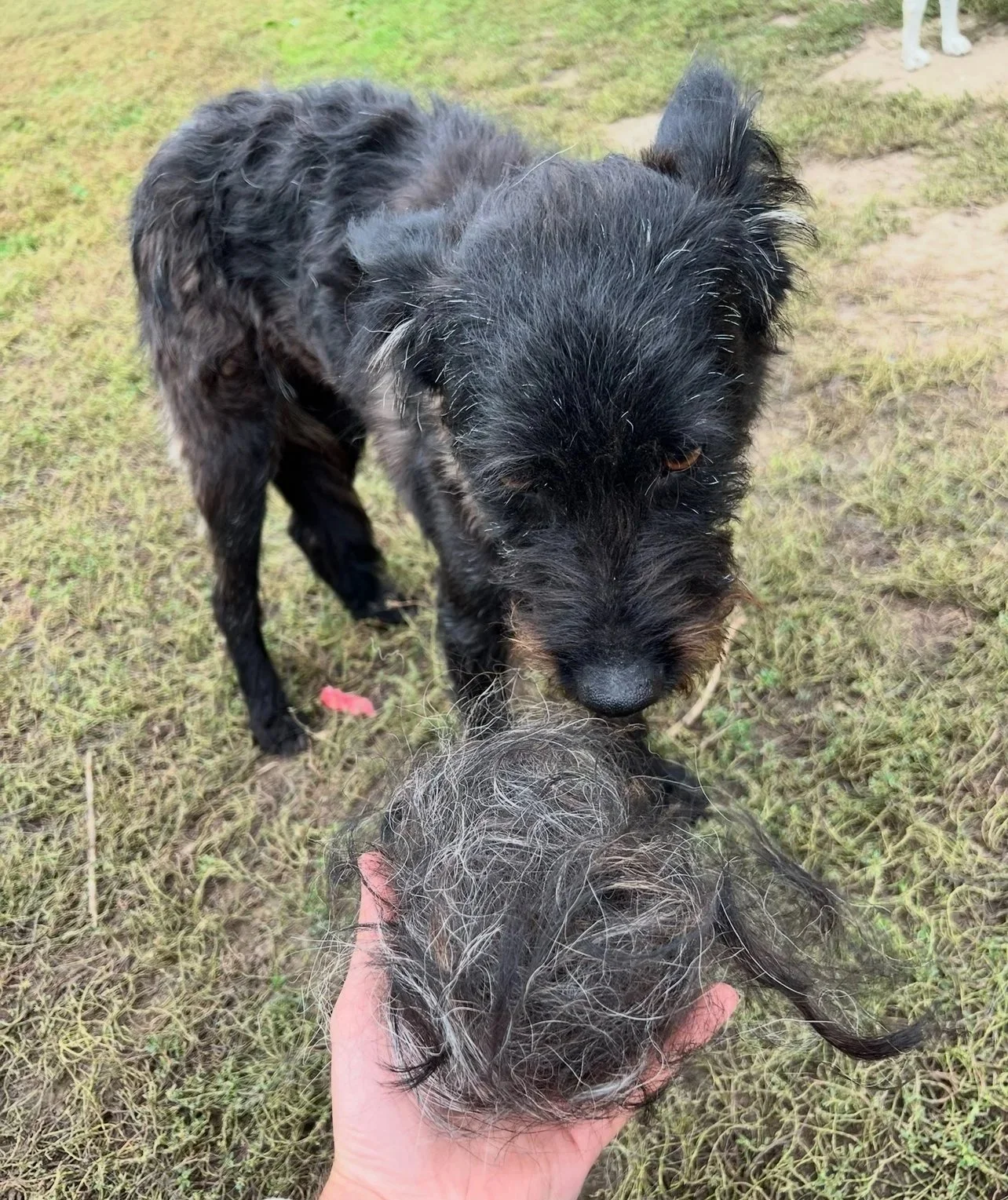
And that distinction is exactly what makes dog undercoat so compelling today. This is not an extractive material. No animal is bred, confined, or farmed for its fibre. Dog undercoat already exists as a byproduct of care — brushing, grooming, seasonal shedding. It is material that would otherwise be discarded.
What makes Chiora’s contemporary approach different isn’t rediscovering the fibre itself, but rethinking how it can exist within a modern, ethical system. The challenge — and the opportunity — is to create a scalable, circular supply chain that benefits everyone involved, particularly rescue organisations and shelters. Fibre can become a form of support, turning routine care into meaningful contribution.
Technically, the material is extraordinary. Dog undercoat is up to 80 percent warmer than sheep’s wool, with a fineness comparable to cashmere. It is lightweight, breathable, and surprisingly luxurious — soft without being fragile, insulating without bulk. Historically valued for warmth, it aligns effortlessly with modern expectations of comfort and performance.
In a world searching for sustainable materials, the answer may not always lie in something new. Sometimes it’s a matter of remembering what we already knew — and choosing to use it differently.
Dog undercoat asks us to rethink value, scale, and care. Not as nostalgia, but as practical reconsideration of what sustainable materials can be when companionship, circularity, and craft intersect.

Reference List
Cecco, L. (2024). An Indigenous woolly dog went extinct in Canada. Could it be revived? [online] the Guardian. Available at: https://www.theguardian.com/world/2024/jan/27/salish-wooly-dog-extinct-indigenous-people-canada. [Accessed 6 Feb. 2026].
Hassall , J. (2026). British Dogs’ Wool Association Special Appeal to Dog-Owners in Kensington. [online] Imperial War Museums. Available at: https://www.iwm.org.uk/collections/item/object/42993 [Accessed 8 Feb. 2026].
John (2022). St John the Evangelist Knotty Ash. [online] St John the Evangelist Knotty Ash. Available at: https://www.stjohnsknottyash.org/blog-articles/2022/8/4/dogs-trust-merseyside?utm_source=chatgpt.com [Accessed 10 Feb. 2026].
Jollie, P. (2020). A Woolly Tale: Salish Weavers Once Raised a Now-Extinct Dog for Its Hair. [online] NMAI Magazine. Available at: https://www.americanindianmagazine.org/story/a-woolly-tale.
Sandra Miller (2015). 1918 Red Cross and British Dog Wool Assn. spin Chow fur for war effort - ChowTales. [online] ChowTales - History, stories and archive of the Chow Chow. Available at: https://chowtales.com/1918-red-cross-and-british-dog-wool-assn-spin-chow-fur-for-war-effort/ [Accessed 8 Feb. 2026].
Wovember. (2015). Friday Night Vi-EWE-ing – when ‘wool’ isn’t wool. [online] Available at: https://wovember.wordpress.com/2015/11/13/friday-night-vi-ewe-ing-when-wool-isnt-wool/?utm_source=chatgpt.com [Accessed 10 Feb. 2026].